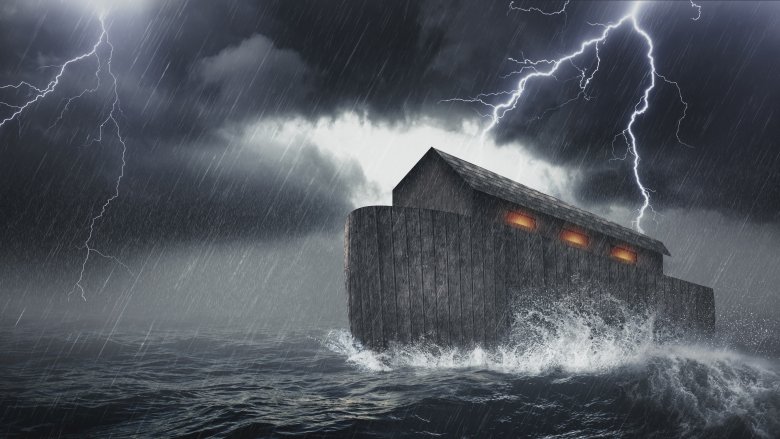
Historical Evidence for the Great Deluge
There is a lot of controversy surrounding the story of Noah’s Ark. Probably a thousand pages or more have been written either defending its record provided in Genesis chapters six through nine as accurate, or attacking it as nothing more than a poorly crafted piece of mythology, stolen from other, more ancient sources and repurposed in the Bible to make us fear God and His prophets.
This line of attack is neither new; nor is it relegated to the story of Noah’s Flood (a.k.a. “The Great Deluge”). Much of the Bible has been attacked for borrowing stories from more ancient civilizations, narratives, and myths. But the fact that we have two separate historical accounts, with hundreds of years between the two, with many details that contradict each other, shouldn’t be used as evidence that either or both are false.
Consider the accounts given by the four writers of the gospel accounts, the first four books of the New Testament. One account, the book of John, varies widely from the others. And in those other three accounts there exist variations that are hard in some cases to reconcile effectively. Yet Christians generally accept these accounts as honest renditions of what their writers actually saw, experienced, and/or heard. And these are accounts that were all laid down within, at most, 40 or 50 years of each other.
Was Noah A Historical Figure?
So the first question to ask is, “Does the fact that the Epic of Gilgamesh and the story of Noah’s Ark are separated by many hundreds of years automatically mean that the latter account (Noah’s Ark) borrowed from the former (Epic of Gilgamesh)?” Here’s an article that breaks down in great detail the differences between the two accounts. In it, the author describes several important differences between the two.
Most notably, the biblical account of Noah’s Ark makes it clear that the God of heaven is displeased with man’s activity on earth, and is about to destroy everything for that reason. Though the Epic of Gilgamesh is similar, it references the polytheistic worship common among people of that time.
In addition to the Epic of Gilgamesh, there are over 200 accounts very similar in nature to the Genesis story found all over the world! The fact that there are so many stories that share so many details points to a common historical event that actually happened. Here’s a link to a page that contains many of the more prominent historical accounts of that event.
The Village Of Eight
Next, there is a place in Turkey called, “The Village of Eight”, as in the eight people that went aboard Noah’s Ark. But it’s not just the name that’s significant; it’s the history behind the location and where the name comes from. If Noah was just a local guy that encountered a local flood; if the boat was simply a means of escaping to another local where the floodwaters didn’t reach, then the name would be meaningless, since the village would have had people already there waiting when Noah and his family got off the ark.
Here’s a graphic that shows the migration patterns of people and languages out of Anatolia, which is modern-day Turkey:

Another article describes what might be the actual home of Noah and his wife:
A few miles from the site of the ark, in the Araxes Valley, is a vast complex of extremely ancient stone fences radiating outward from an ancient stone house. Behind this complex (to the north) is a very ancient stone altar located upon a ridge between 2 hills. In front of this house Ron found 2 tombstones which indicated that they were marking the graves of Noah and his wife, and therefore we believe this was Noah’s home.
Also located in the area are huge stones with holes bored through them. It is thought that Noah used these stones to “anchor” his boat in the water, keeping it facing perpendicular to the waves so it wouldn’t capsize. Since the underwater currents would have pushed and pulled the anchoring stones, it would have kept the boat properly situated in the water. Here’s an article showing some of those stones.
Conclusion
Certainly, there are many questions surrounding Noah’s Ark that remain to be answered. Those who resist the truth will continue to ask questions, and it should not be our goal to completely stop the mouths of the scoffers and Bible-deniers. What we can do is offer compelling evidence that should set at ease the mind (and heart) of the serious Bible student. If you’re looking for evidence to strengthen your faith, here is ample evidence to do just that, from a historical perspective.
In another article, I’ll provide answers to some of the more challenging scientific questions (like how did Noah get all those animals on the ark?). For now, please take the time to read through the evidence provided, and let me know if you have any questions below.
If you enjoyed this article, please do me a favor and hit the “like” button. If you want to be notified when I produce more articles like this, please take a moment to sign up with the form below.