Coronavirus and Evolution

Evolutionists consistently claim that evolution has been proven beyond any reasonable doubt. Yet recent DNA analysis of the latest coronavirus, along with comparisons of other members in the coronavirus family, should cause us to question those claims.

After the latest outbreak started resulting in multiple infections and deaths, scientists (specifically virologists) began studying this latest virus.

By comparing the two dozen genomes, scientists can address the “when did this start” question. The 24 available samples, including from Thailand and Shenzhen as well as Wuhan, show “very limited genetic variation,” Rambaut concluded on an online discussion forum where virologists have been sharing data and analyses. “This is indicative of a relatively recent common ancestor for all these viruses.”

https://www.statnews.com/2020/01/24/dna-sleuths-read-coronavirus-genome-tracing-origins-and-mutations/?fbclid=IwAR25FxqIpLBB6d5NYnoADLo2iAKsfVZRrOuepR2kCAx7fAs6jP2KBBspkQo

Just how recently did this particular virus emerge? The same article1 tells us that it first emerged somewhere between Oct. 30 and Nov. 29 of last year (2019). So this is a new virus that hasn’t been seen before in the human population. Not only that, but all the variants now out there came from a single parent that emerged from a single source. That’s very important because the theory of macro-evolution (molecules-to-man over billions of years) would seem to indicate that it’s entirely possible for evolution to occur along multiple lines concurrently. So rather than just one single ancestor, evolution should expect to see multiple ancestors arising from multiple sources. Yet that’s not what happened here.

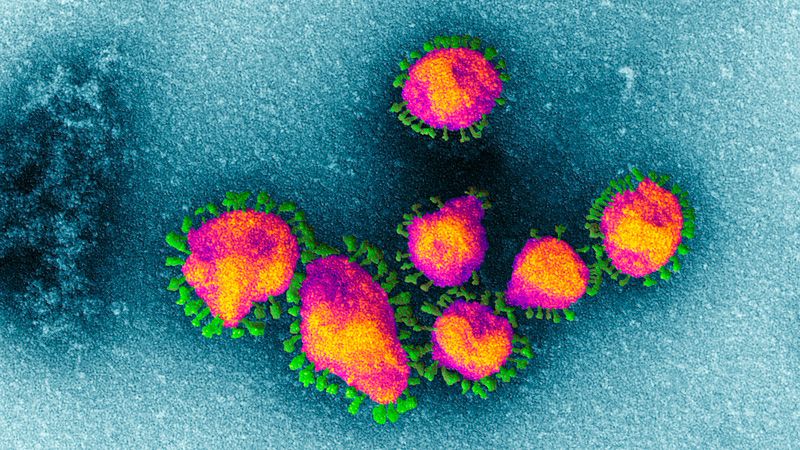
What Is the Coronavirus?

This website2 gives the answer: ” Coronaviruses are enveloped RNA viruses that are distributed broadly among humans, other mammals, and birds and that cause respiratory, enteric, hepatic, and neurologic diseases.” The same site goes on to say,

Six coronavirus species are known to cause human disease. Four viruses — 229E, OC43, NL63, and HKU1 — are prevalent and typically cause common cold symptoms in immunocompetent individuals. The two other strains — severe acute respiratory syndrome coronavirus (SARS-CoV) and Middle East respiratory syndrome coronavirus (MERS-CoV) — are zoonotic in origin and have been linked to sometimes fatal illness.

This new strain, now called, “2019-nCoV”, is the seventh known coronavirus which affects humans, and is similar to SARS and MERS in that it also causes respiratory infection, resulting in death to some patients. The second article goes into some detail as to how the genome of this new virus was sequenced, and then tells us how similar the new virus is to SARS – “more than 85%”. After more research was done, a more concrete number was derived: 86.9% similarity.

Now let’s think about this for just a moment. Here we have two viruses of the same family (coronavirus), both of which are the same type of strain – the type that causes severe respiratory infection. And yet these two viruses only share 86.9% of their DNA. This is important, because humans and chimps are said to share more than 98% of their genome, yet these two species are separated by millions of years of evolution.

Twenty-three strands of the 2019-nCoV virus have been sequenced, and very “little genetic variation” was found.3 Just how little difference? 0.05%, according to another article.4 This article goes on to say that this virus is 92% similar to another bat virus, RaTG3, “which argues for bat origins for the 2019-nCoV”.

So let’s review what we have so far:

  • A new coronavirus outbreak occurred between Oct. 30th and Nov. 29th, 2019.
  • This new virus is 86.9% similar to SARS, another deadly coronavirus.
  • It is 92% similar to RaTG3, another bat virus, indicating that 2019-nCoV is of bat origins.
  • The genome of 2019-nCoV is 30,000 nucleotides long.
  • The human genome, by comparison, is 3.2 billion nucleotides long!
  • The human genome is roughly 110,000x bigger than the coronavirus.

Conclusion

“Okay”, you may be wondering, “what does all of this have to do with anything?” Think about this for just a moment. If you google the similarity between humans and chimps, you’re told that these two creatures share about 99% of their DNA, making the chimp “our closest living relative”.

Yet the closest living relative to the newest member of the coronavirus family, RaTG3, is only 92% similar. We know this because we’ve mapped out all 30,000 nucleotides and compared them. Yet humans and chimps, both of which are over 100,000x bigger, are said to share 99% of our DNA. The above-mentioned facts should forever dispell the notion that humans and chimps are so closely related. It’s simply not possible, given what we know about the coronavirus family members.

Humans probably share over 99% of our DNA between our species (maybe as little as 92% between some members), but it simply is not possible that we share 99% of our DNA with chimps. It’s time to expose it for what it is: a lie told by people with an agenda to destroy your faith in the Bible.

The Problem(s) With Evolution

In Peter’s second epistle, we read these words:

“Knowing this first, that there shall come in the last days scoffers, walking after their own lusts, And saying, Where is the promise of his coming? for since the fathers fell asleep, all things continue as they were from the beginning of the creation. For this they willingly are ignorant of, that by the word of God the heavens were of old, and the earth standing out of the water and in the water: Whereby the world that then was, being overflowed with water, perished: But the heavens and the earth, which are now, by the same word are kept in store, reserved unto fire against the day of judgment and perdition of ungodly men.” (II Pet. 3:3-7)

Peter was evidently some kind of prophet! All around us today are those who attack the Bible, and their attacks usually fall within two main arguments: Creation, and Noah’s Flood. We are told that science has settled the issue, that the Creation of the earth did not happen as described in Genesis chapters one and two, and that humans have evolved over the long ages from chimps and other life forms, all originating from a single-celled organism about four billion years ago (Bya).

But there are two questions we must ask:

  1. Is this true?
  2. If it is true, how would we know?

As Pilot asked Jesus, “What is truth?” How are we to determine what is true and what is not? If the Bible is true, there ought to be a way we can figure that out. If evolution is true, there should be some way to prove it.

But here we reach a conundrum, because there is absolutely no way to prove either one to such a high degree of certainty that it would banish all doubt or argument. There are those who disbelieve the account of Noah’s flood because they don’t see how it could have happened as described in the biblical narrative. They dismiss the story of creation for the same reason. And yet the story of evolution is not without its own problems, either. I’ll describe the major ones below.

Problem 1: The Big Bang

The Big Bang supposedly happened about 13.8Bya. All of the matter in the entire universe is said to have been contained in a super-dense dot smaller than the period at the end of this sentence. But here we enter the realm of almost certain impossibility, for we are told that the dot itself came from nothing.

So, basically, nothing exploded, and something happened. This is the story children are told about how the universe came to be. Yet there are at least two scientific laws that defy this explanation.

  • The Law of Inertia states that a body at rest will remain at rest unless acted upon by an outside force. So in order for the Big Bang to be true, some outside force must have acted on the nothing which contained everything, causing it to explode. This brings up several questions, none of which can be answered by science definitively. All we can do is speculate since the theory itself is mere speculation:
    • What was the force that acted on nothing?
    • How can nothing contain everything?
    • What caused it to explode?

These are all questions that defy explanation! And yet we’re told it must be true.

  • The Law of the Conservation of Mass Energy states that matter can neither be created nor destroyed. Therefore, no matter could have been created by the explosion. All of the matter present in our universe today had to have always existed, though the form could have been different. Evolutionists claim that the universe did not need a Creator, yet the Law of the Conservation of Mass Energy says differently.
    • Where did all of the mass in the universe come from?
    • How is it possible that all of that mass existed in such a small space?


Problem 2: The Origin of Life

We are told that all life on earth evolved from a single-celled organism that came to life about 4Bya. His daddy must have been so proud! Oh, wait…he didn’t have one. But…how can a life form not have a father? This is known as “abiogenesis”, and is defined as, “the original evolution of life or living organisms from inorganic or inanimate substances.” Yet there are several very big problems with this idea!

  • The Law of Biogenesis states that life can only come from life. There used to be a theory called “Spontaneous Generation” which taught that in certain circumstances, life can come from non-life. Yet every experiment which tried to prove that came up empty. Just as matter cannot be created from nothing, just as a stationary object can’t spontaneously start moving, non-living material can’t spontaneously come to life. And yet we are told that about 4Bya, evolution defied scientific law, and did just that!
  • There have been many attempts to jump this insurmountable hurdle, all related to the fact of molecular self-assembly. Under certain conditions, certain molecules (the basic building blocks of life) can assemble themselves. Yet no experiment has ever been successful at either (a) getting the requisite number of molecules needed to self-assemble, (b) getting them to assemble in the correct order, nor (c) figuring out how to make non-living molecules come alive.
  • Not only did the non-living material have to somehow figure out a way to come alive, but next it had to figure out how to reproduce itself. In the only-once-in-four-billion-years chance that this could have happened, it would have been utterly worthless if the prototype couldn’t figure out how to make copies of itself. If it couldn’t figure that out, then oh well. I guess we’d have had to wait for the next nothing to explode, create a solar system, spin off a habitable planet, and get just the right nutrients together in just the right combination at just the right time for lightning to strike.

But that brings us to the next problem:


Problem 3: DNA

DNA is a real problem for the evolutionist. Oh, they love to compare DNA samples (which are selectively chosen and rearranged to provide favorable results) of different creatures, especially humans and chimps, to show how similar they are. But don’t ask them about the origin of DNA. They don’t like to talk about that. You see, DNA is not just a self-replicating molecule. It’s actually a set of instructions, much like a computer code. As I’m typing this out, I’m tapping some buttons with letters on them, and the keyboard sends signals to the computer’s processor, which then sends signals to the screen, telling the screen which letters to print on the screen. I can tell you that the computer gets it right every single time, even when I don’t.

Your DNA is much like this computer program. It tells the cells (the hardware) what to do, where to go, and how they should respond. Charles Darwin reportedly said, “How a nerve comes to be sensitive to light, hardly concerns us more than how life itself first originated“. Naturally. Since the question of how life began is too complex for evolutionists to answer, it would make perfect sense that they would dodge the next question as well: why is one nerve sensitive to light when another is not? The answer: DNA. The DNA controls which nerves get the photoreceptors and exactly where those photoreceptors are supposed to go. And the cells always follow the instructions given by the DNA precisely. (By the way, if evolution were true, shouldn’t we expect that some cells would do their own thing and not follow the DNA’s instructions? Why, just look at those amazingly rebellious cells, pushing evolution along in spite of what daddy tells them to do!)

Here are some of the problems with DNA:

  • DNA is a code. As such, it must have a developer. Nothing as complex as a DNA molecule could possibly have arranged itself, just as no computer can write its own code. That code must have come from some intelligent source. Yet the modern evolutionist leaves no room for an intelligent Designer to have created the code. Therefore, it MUST have arisen spontaneously.
  • The DNA molecule, just like any other molecule, is incapable of protecting itself from such things as radiation or deterioration. It is water-soluble. If left unprotected, it will dissolve. Therefore, it has to be protected by a cell, which itself is protected by a cell membrane. Yet the cell membrane forms in response to instructions from the DNA molecule inside the cell. So the question can be asked, “Which came first, the cell, or the DNA?” To which there is no reasonable answer. In spite of all the tests and protestations to the contrary, no evidence has yet been produced which shows anything other than that the cell and the DNA must both have come into existence simultaneously, for one cannot exist without the other. (There are attempts to get around this little conundrum, but for now, no solid answer has been forthcoming.)

As one author said,

Evolutionists would have us to believe that non-living elements and molecules joined together and developed increasing biological capabilities. Those who believe in intelligent design reject this hypothesis, insisting that neither RNA nor living cells are able to evolve spontaneously. While some disagreement exists among those in the evolutionary community on the time frame for such alleged reactions to occur, the consensus is that, given large amounts of time, single-celled bacteria were formed. But all known biological principles militate against this notion. Even billions of years could not provide mechanisms for the reaction products to evolve advantageous characteristics and form DNA and cell proteins, let alone create strings of RNA nucleotides, arriving at just the right sequence in order to code for a functional protein. The four nucleotide bases that form RNA (adenine, guanine, cytosine, and uracil) can be arranged in an exponential array of combinations and lengths. For an actual, functional protein to be coded, a precise sequence of nucleotides must be obtained. Forming the code for even one protein by evolutionary means is impossible, without even considering the necessity of the number that work together in a single cell.

http://apologeticspress.org/apcontent.aspx?category=12&article=2317


Problem 4: Fossils

Fossils are actually a problem for the evolutionist. Why? Because fossils don’t form under normal circumstances. When creatures die, they usually just rot away. It’s highly unusual for fossils to form. And yet we find fossils in the millions! Why? Add to this the fact that fossils are not currently being formed, and we must conclude that conditions were different when those fossils were formed. Obviously, they are there, and they weren’t put there by humans. There’s no giant hoax going on to plant false evidence of something in the ground. So something must have occurred in the past which is not occurring today.

Here’s a site that tells us, “Fossils are formed in a number of different ways, but most are formed when a plant or animal dies in a watery environment and is buried in mud and silt.” So most fossils are formed by being buried underwater. (Hmmm…let me think…isn’t there some record somewhere of a massive, cataclysmic water event?)

Evolutionists have successfully redefined both fossils and their watery graves, creating imaginary timelines out of thin air, and distributing these fossilized remains such that they no longer all relate to a single cataclysmic event, but to many events spread out over millions upon millions of years. To support their imaginary timeline, they rely heavily on something called “radiometric dating”.


Problem 5: Radiometric Dating

Radiometric dating is not the kind of dating that results in a meaningful relationship. I’m sure every woman has dated a guy that seemed like a rock, but geologists date actual rocks. (Do they have rocky relationships? Is their relationship ever “on the rocks”?) Anyway…

Radiometric dating involves things called isotopes. A radioactive isotope decays to become a stable (non-radioactive) isotope. For example, we know that uranium-238 decays to lead-206 at a certain rate. So by looking at a fossil and measuring the levels of lead-206 against the levels of uranium-238, we can tell with some degree of certainty how old the fossil is. But there are major problems with radiometric dating:

  1. The scientist must make an assumption as to the amount of the parent isotope that was in the fossil when it was buried.
  2. The scientist must make an assumption as to the amount of the child isotope that was in the fossil when it was buried.
  3. The scientist must assume that the rate of decay has remained constant for the entire time the fossil has been in the ground.

These are all assumptions that must be made before the geologist can make an educated guess as to the age of the fossil. And because these assumptions are built into the evolutionary model, and since evolutionary scientists around the world use the same model with the same mathematical formulas to determine the ages of fossils, it’s easy to see why they all come up with similar ages for the same fossils. They’re all taught to make these same assumptions.


Problem 6: Transitionary Organisms

If evolution were true, we should expect to see so many different transitions of organisms from one form to another that it would be impossible to tell where one started and the other stopped. For example, dogs and horses, we are told, both have a common ancestor. So why do we have two separate species which are so clearly defined? Even when you have a dog and a horse of the same size, one can clearly tell the difference between the dog and the horse. There are so many differences between the two it would seem incredulous that they supposedly have a common ancestor.

Yet if enough pictures, caricatures, and wax sculptures are made in museums, even the most impossible thing can become possible! So here we have two completely different animals which are supposedly linked by some mysterious ancestry.

But if that were true, should we not expect to see lots and lots of creatures in between dogs and horses of such variety that it would be impossible to tell where one stopped and the other started?

Interestingly, even within the same kind of animal, it’s possible to distinguish breeds most of the time (except for “mongrels” which are of mixed breed). Give me the name of any breed of dog, and you can find traits specific to that breed, no matter what breed it is. Different dogs have different traits which make it distinguishable from other breeds of dog, and yet they all belong to the dog family. If evolution were true, how is this possible?

One would expect instead that there would be no such thing as a specific dog breed possible, since every dog would contain trace amounts of DNA from all the other dogs. It really should be (if evolution were true) completely impossible to tell where one dog breed starts and another stops. I’d be curious to find out how similar the DNA structure is between the various dog breeds. As we are (falsely) told that humans and chimps are 98% similar, we should expect that all the dog breeds of the world are about 99.999% similar. How much variation in DNA does it take to differentiate one dog breed from anther? This fact alone should dispell the myth that humans and apes are so similar. Yet the myth continues.


Conclusion

Those who hold to the theory of evolution tell us that the Bible is false. They tell us that evolution has been “proven”. Yet the Christian who believes the Bible should find no reason to doubt that the Genesis account happened exactly as it was recorded. The historical record put down by Adam and secured for posterity in the book of Genesis is a believable account of actual events. “His record is true.”

Just because someone does not understand the why or the how of the Bible does not give us reason to disbelieve what it says. Rather, if we wish to disprove the Bible, then ample evidence should be brought forth which conclusively shows beyond any reasonable explanation to the contrary that the biblical account is false. To date, no evidence has been brought to light.

We have a choice. We can either believe the Bible, or we can believe the men who tell us that the Bible is wrong. Each of us must make that choice. No one can make it for us. In the end, we believe what we want to believe, because there is no evidence that could ever conclusively prove, to the exclusion of all arguments, that either one or the other is true. So the question before us is, will we believe God, or will we trust Man?

I invite your comments below!
“Badgers” Defended

There are many criticisms of the AV 1611 Bible. This is part of an ongoing series to defend the translators in their selection of word choices.

One such choice is the word detailed here – badger. Thirteen times in the Old Testament, Moses wrote that the Levites were to use “badgers’ skins” which were to be freely given by the people (Exodus 25:2,5). But there’s a huge problem: badgers, because they have paws and walk on all fours, are considered an unclean animal (Lev. 11). Verse 27 of the same chapter says whoever even touches the carcass of such dead animals (as a badger) will be unclean until evening.

The charge, then, is that since God wouldn’t want His holy people eating or even touching the carcasses of dead badgers, there’s no way He would have them killing badgers and using their pelts as coverings for the tabernacle and its vessels, like in Exodus 36:19. Many newer versions translate the root Hebrew word “táhásh” as some other animal. But most of these other animals used in the newer versions have the same problem – they are unclean according to the dietary rules set forth in Leviticus 11. A few new versions don’t use an animal word whatsoever, leaving it up to the reader’s imagination.

So the main problem is: Why would God use the skins of unclean animals to cover His tabernacle, especially when skins of clean animals are readily available?

For many, this makes no sense whatsoever. I will here attempt to shed some light on possible reasons why the use of the word “badger” would be an accurate translation.

First, the use of the word “badger” as a classification of animals is dubious even today. Simply do a Google search on the word, and you’ll find that modern biologists are in disagreement as to which species ought to be defined as badgers. It seems of more than a little interest that while there is no agreement on the use of the Hebrew word “táhásh” in scripture, there is also much debate on the classification of the badger. It’s a little difficult to prove something wrong when the witnesses don’t agree with each other on what is right. It’s almost as if they’re saying, “We don’t know what it should be, but we know it shouldn’t be that!”

Second, there’s the sequence of scripture. When the furniture for the tabernacle was being made, they were still situated at Mt. Siani. They didn’t move until all of the various parts of the tabernacle had been completed. Yet the commands about the clean and unclean animals in Leviticus eleven clearly were not given until after all the work had been completed. Is it possible that God withheld those commands until AFTER the work for the tabernacle had been completed on purpose, so they wouldn’t have to worry about being unclean? It certainly seems plausible. And if it’s plausible, then it’s also plausible that “badger” is indeed the correct translation of the word “táhásh“.

Third, we must remember that the tabernacle was itself one great big type. Therefore, it would be reasonable to look at the badgers’ skins as a type of something else. After all, if God did command His people to use the pelts of unclean animals as part of His building, there must be a reason for that. What if every time they looked toward the tabernacle, they saw it covered with the pelts of unclean animals. Surely, that would have been quite conflicting!

And yet, here once again is a beautiful symbol hidden in plain view. There were ram’s skins dyed red, and badgers’ skins which were not dyed at all. These represent the clean and the unclean, the acceptable and the reprehensible both together in one place. The Ram’s skins represent the Jew who is accepted of God and beloved. He is clean. The badgers’ skins represent the Gentile, who is unclean. Both are accepted at God’s tabernacle because He makes both pure in His sight.

The New Testament tells us that, “In Christ, there is neither Jew nor Gentile.” To the outside world, they saw the outside of the covering. But from the perspective of God from the inside, all skins look the same. From the inside, it’s hard to tell one pelt from another. They all look very similar, aside from their shape. With God residing inside of us, He cannot tell a difference. To Him, there is no separation between the unclean Gentile and the purified Jew.

In deciding to use the pelt of an unclean animal as part of the tabernacle, God was signaling to the Jews early on that their religion wasn’t just for them. God was going to use them to be a blessing to all the nations, and all nations would be welcome at His temple, just as the skins of both clean and unclean animals were used to cover it.

Types and Symbols – Genesis 1

The Bible is an amazing book. Just reading the plain text of the Bible, one can get a sense of its rich poetry, story-telling prose, and purity of speech. The Bible gives us a sense of where we’ve been and where we are going (historical and prophetic accuracy). It accurately describes what and who we are, and the world we live in (scientific accuracy). And it gives us the authoritative words of God (manuscript authenticity).

But dig just a little deeper, and one will find that the Bible is also a book of things called “symbols” and “types”. Most of the symbols in the Bible are explained in the Bible, so they aren’t that hard to figure out. But typology is another story altogether. In this opening chapter of Genesis, we find several types already given to us. I will attempt to unpack and explain a few of these for the reader.

Genesis 1:1 says, “In the beginning, God created the heaven and the earth.” There are three objects in this first verse: God, heaven, and earth. This is important because, over the next several verses, each of these subjects is going to be covered in type a couple of different times. Here’s something interesting as well: the Bible is a book of numbers, and numbers represent different things in scripture. Numbers are important.

Genesis is the book of beginnings, and the number 1 is the first number. It is the number of beginnings. Jesus says, “I am the Alpha…” that’s the prime, the first, the source. And so God is mentioned first in the first verse of the first book. All positive integers can be created using other numbers except the number one. There’s also the verse reference, “1:1”. A colon “:” between two numbers in math indicates a ratio or a comparison. If one is compared to one, the answer is one. Any number compared to itself will always yield itself. The only thing we can compare to God is Himself.

But if we add 1 + 1 instead of comparing them, we get 2. So now you have one and two. Genesis, the first book of the Bible = 1. The first book with the first chapter (1 + 1) is two. The first verse of the first chapter of the first book, then, would give us 3 (1 + 1 + 1). So right there in the first verse, we have a singularity, a duality, and a trinity.

Think of it this way:

123
GodHeavenEarth

This is important, and we’re going to see this played out over the rest of the chapter. In verse 2, we start from the earth and move backward: “And the earth was without form and void, and darkness was upon the face of the deep, and the Spirit of God moved upon the face of the waters.” So verse 2 is a mirror image of verse one. The number 2 in the Bible usually represents a mirror image. In geometry, the concept of parallel is represented with two lines facing each other but never meeting. And this is what we see, for the “deep” is a mirror image of the “heaven” (more on that later). So let’s add this to our table:

123
GodHeavenEarth
SpiritDeepEmpty
LightHeavenEarth

Verse three starts the first account of creation with the creation of Light. Verse four gives us the first time God divides something, in this case, the light from the darkness. In verse five, He names them. The light is “Day” and the darkness is “Night”. Thus we end Day One.

In verse six we have this thing mentioned called a “firmament.” Then in verse seven, we’re told what it does: divide the waters under it from the waters above it. Now, as this is Day Two of creation, and two represents a mirror image, it makes sense that we would have something dividing the mirror from its image. Finally, verse 8 tells us what this “firmament” is. God calls it “heaven”. Here we see:

Water“Heaven”Water

Now it’s important here to note (for theological reasons) that this heaven is different than the heaven created in the beginning. This is a brand new thing created on the second day of creation which separates the waters under it from the waters above it. So this is a division in space. We’re going to see this detailed in the next few verses.

On Day Three, God does even more separating. This time He’s going to separate the “water” from the “land” and “let the dry land appear”. He calls the dry land “Earth” and calls the waters “Seas”. Day Three is also the first time we have life appearing on the Earth. So let’s update our table with what we have so far:

123
GodHeavenEarth
SpiritDeepEmpty
LightHeavenEarth

So we start with God, the source of life in the top left corner of the table, and end with life on the earth in the bottom right corner of the table. But wait! We’re not done yet. Day Three is also a mirror image. We start with verse ten where God calls the dry land “Earth. Then God calls the waters “Seas”. Finally, He ends with life in verses eleven and twelve:

LightHeavenEarth
LifeSeasEarth

In Day Four, God creates lights “in the firmament of the heaven” to divide day from night. He gives four reasons for creating these lights on day four. We cannot help but get the impression that the number four is being stressed here in verse fourteen (4 + 10). It’s difficult to think that this is simple coincidence. The four reasons all have to do with the earth:

  • Signs (to provide navigation, reference points, and tell the Bible narrative)
  • Seasons (to mark times of sowing and harvest, among others)
  • Days (small passage of time)
  • Years (large passage of time)

This is the first time the number four is associated with the earth. As the Bible goes forward, we’ll see more references to the number four being associated with the earth.

On Day Five, we see God once again using the mirror image. He creates both the water animals and those that fly “in the open firmament of heaven”. Then on Day Six, God finally finishes His creation with the land animals and humans. Look carefully at verse 26, though, and you’ll see something interesting. Instead of being a mirror image as was true on the other even days, Day 6 flows like the odd days, starting with Man being created in God’s image, and then being given dominion over the fish, fowl, and creatures of the earth: “And God said, Let us make man in our image, after our likeness: and let them have dominion over the fish of the sea, and over the fowl of the air, and over the cattle, and over all the earth, and over every creeping thing that creepeth upon the earth.”

It’s not until verse 28 that you get the mirror, with a separator in between: “So God created man in his own image, in the image of God created he him; male and female created he them.” Also, the separator has two mirror images of its own: the mirror of God and Man, and the mirror of Man and Woman.

Here’s verse 28: “And God blessed them, and God said unto them, Be fruitful, and multiply, and replenish the earth, and subdue it: and have dominion over the fish of the sea, and over the fowl of the air, and over every living thing that moveth upon the earth.” So we start with God telling them to fill the earth, then He gives them dominion over the fish and fowl, and ends with all life.

So here’s the final table, complete with arrows indicating direction, and numbers for each day:

→0GodHeavenEarth
←0SpiritDeepEmpty
→1-3LightHeavenEarth/Life
←3LifeSeasEarth
→4-6LIghtsWater &
Air
Creatures
Land Animals
and
Man
←6All LifeSea Creatures Man Rules
Over

Symbols and types aren’t just put there for our curiosity. They all have a meaning. So what meaning, what practical application can we draw from this? You should be able to see that there are three sets, each starting with God and going back to God. From this we can conclude that everything starts and ends with God. God is both the author and finisher of life. It doesn’t start with God and end with Man; it starts with God and ends with God.

Second, we can see the declination in order. It started with God giving everything order, but ends with Man in dominion of God’s creation. We begin with God being a law unto Himself; we end with God giving man His Law, which will keep all things in proper order if it is kept.

What do you think about my explanation of Genesis chapter one? I’d love to see your thoughts in the comments below.